

- This event has passed.
Lunar Returns
January 20 - January 25
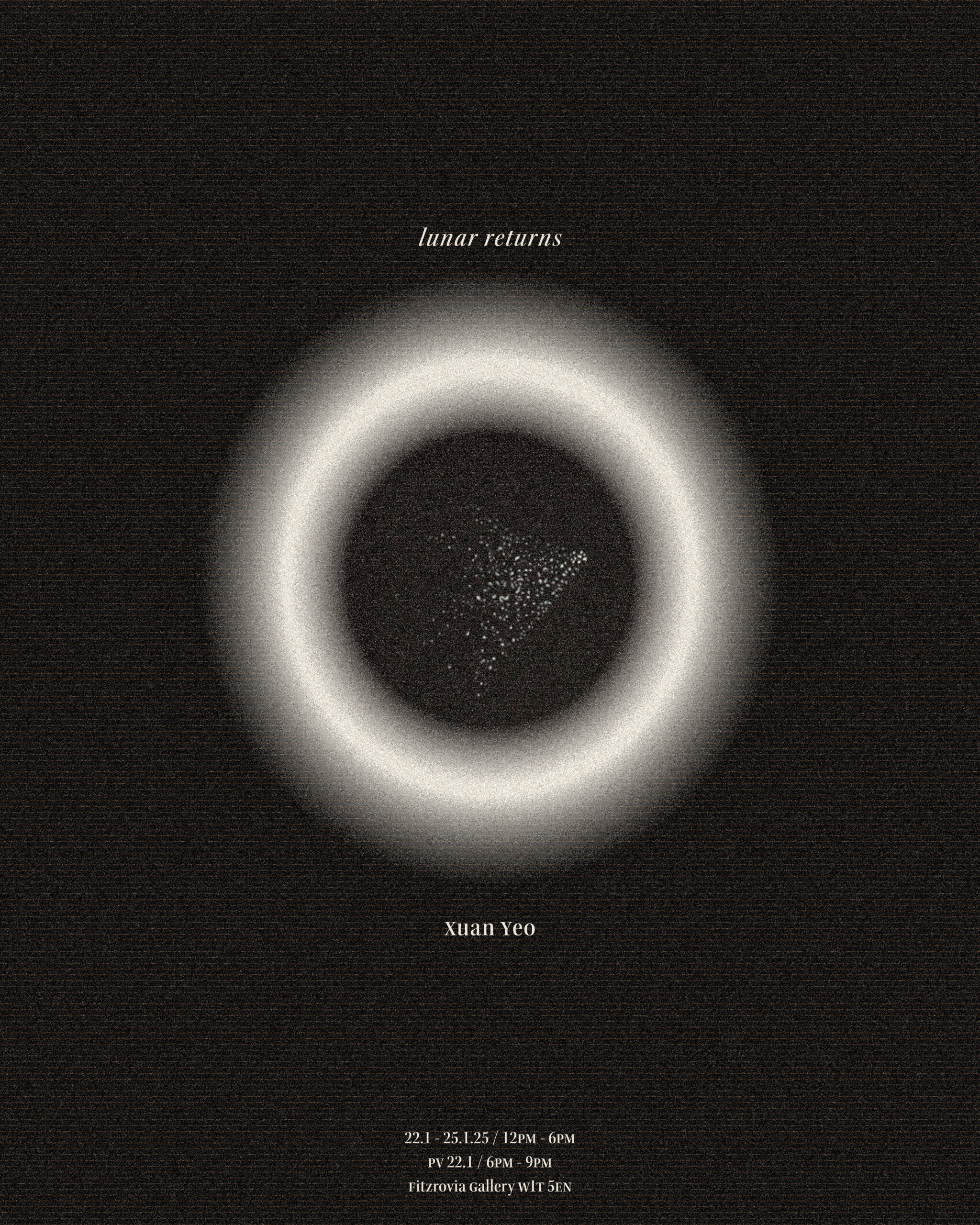
Lunar Returns uses the loom as a method of translation, transforming text into weaving through an encoded system of binary decisions with variable warp ends, density, interval, contraction, and expansion. Across four seasonal panels shaped by Yi Jing dynamics, the works turn to constellations as divinatory tools, fusing Western astrology with Chinese cosmology to materialise weaving as a material grammar of change, where labour registers time through repetition, tension, and origin.
– –
Invoking a movement of time that is cyclical, rhythmic, and relational, through return and modulation as its foundation, the show organises attention through appearance, withdrawal, and reappearance.
With the loom as a medium of translation and transformation, Lunar Returns mobilises weaving as an encoding practice. Through a material language structured by distributions, warp space, thread count, and openweave techniques, the work reconstitutes writings drawn from Xuan’s practice over the past decade. These texts are metabolised into a series of oppositional relations as words are processed through coding, a binaric system which also echoes the binary logic of the Yi Jing, a classical text in Chinese divination and cosmology. Language is simultaneously deconstructed and rendered tactile, holding in tension acts of revelation and concealment.
Drawing on Bachelard’s Poetics of Space (1958) and Tanizaki’s In Praise of Shadows, the weavings mediate sources of light through filtering and diffusion, shaping a space structured by fengshui (Chinese geomancy) and a poetics of interiority. Bachelard’s image of the lamp in the window as the house’s eye names a relation between the inside and outside that takes the form of vigilance and presence.
In classical Sinophone diasporic writing, the moon operates as a shared optic across distances. This functions in tandem with seasonal changes, with Yi Jing hexagrams mapping permutations of mutually opposing forces, a grammar of elemental change. This dynamism is reflected in the natural world and operates in the work through dually binding logic in the warps and tetralemmic logic in the weft, wherein:
spring: 生 (rise)
summer: 長 (growth)
autumn: 收 (gather)
winter: 藏 (rest/hide)
These weavings also take in multiple genealogies of reading the sky, fusing divinatory methods that share an interest in cyclical patterning, from Western astrology’s natal mapping and aspect logic to Bazi time-based pillars and Chinese cosmological correspondences. The sky reflects an archive of “return” beyond lunar phases, referring to the karmic recurrence of the seasons, planets, and the personal. Weaving is hence a spatial, ongoing negotiation with the world and the body.
The moon’s return is an ongoing recalibration between ascension and declination. It abides by a logic of change and continuity, tracing trajectories of departure even as it anticipates all the forms of coming back that remain possible.
Text by Xuan Yeo and edited by Sheryl Gwee
– –
Xuan is a Singaporean-Malaysian textile artist, fabricator, and designer based across Singapore and London. Her practice(s) are rooted in negation and emptiness, in order to activate meditative environments that underscore the extreme labour-intensiveness of their making. Through weaving, perfumery, installation, textual manipulation, and computing, her work productively uses meditation and labour to see through processes in karmic cycles, memory, and spatio-temporal imaginations into being diaspora. Grounded in gnomonic systems of measurement, time, celestial divination and astronomy, based in ancient Vedic scripture, Mahāyāna Buddhism, Euclidean geometry, and Daoist logic, they are mutually formulaic and repetitive.
She has also worked across London and Singapore, such as with A.P.T. Gallery, Starch, Mimosa House, Goldsmiths Centre of Contemporary Art, Constance Howard Gallery, Barbican Arts Group Trust, A Particular Reality, Freelands Foundation, and Mads do & Mend. She is also co-producer for Silkworm Collective in conducting community collaborations, workshops, and marketing. Silkworm have held a residency at the Goldsmiths’ Centre of Contemporary Art and are in ongoing collaboration with Anomalous Space, Miiro Hotels, Greenwich Royal Libraries, and Teaspoon Projects.
She holds a First Class Honours degree in Fine Art and History of Art from Goldsmiths, University of London.