
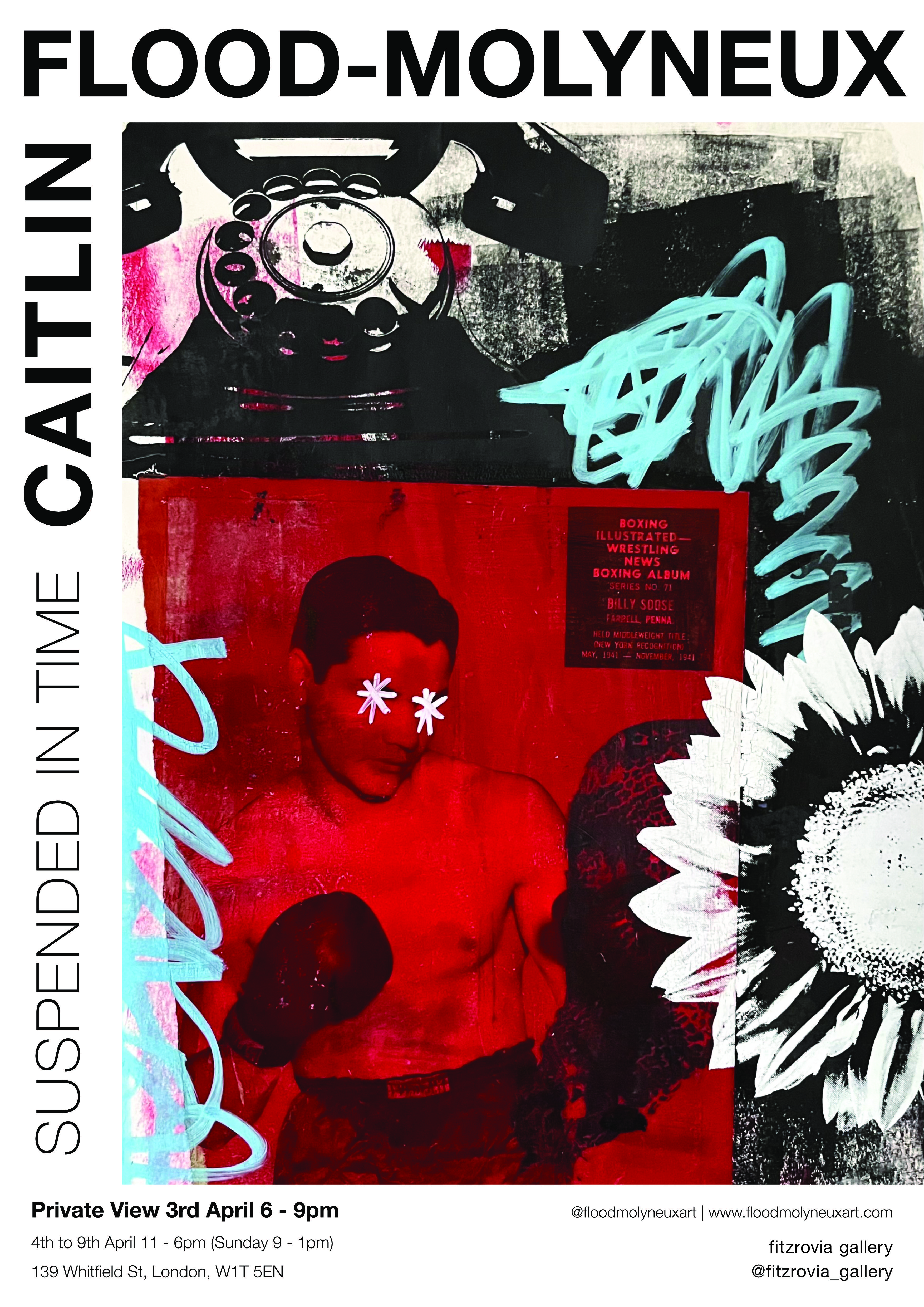
4th– 9th April, open daily 11– 6pm (Sunday 9-1pm)
Private view 3rd April, 6 – 9pm
Caitlin Flood-Molyneux’s artwork offers a powerful reflection on the way we relate to our memories, particularly those shaped by trauma, loss, and love. Flood-Molyneux’s unique artistic practice combines found imagery with abstract painterly forms, resulting in a visual language that reflects the way we connect with our past experiences..
At the heart of Flood-Molyneux’s work is a sense of hope, even in the midst of pain and loss. By giving shape and form to her experiences, she finds a way to make sense of them, offering a path forward for herself and her viewers. Through her art, she reminds us that we can find strength and hope in the face of adversity.
Flood-Molyneux’s work is highly personal and universal at once; accessible to many through its use of iconic imagery and playfulness. It charts key moments in the artist’s life; a private and enigmatic story visualised in works on paper, collages, and paintings.
Caitlin Flood-Molyneux is a contemporary Welsh Artist based in South Wales. Their artistic practice investigates the relationship between pop culture imagery and the way in which we attach emotion and memory to images and use this to narrate their subjective experiences of hardship. Developing from the visual styles of DADA and early Pop Art, the combination of found imagery alongside abstract painterly forms allows them to develop their own visual language. Their use of historical imagery is important, as it embodies the memories which the artist seeks to portray. Their work is both deeply personal and universal, as it charts key moments of their life; a private and enigmatic visual story with which Flood-Molyneux invites the viewer to forge their own connection.
The process of production often begins with collage, taking physical cut outs of imagery that provokes emotion and memory, before recontextualizing them to relate to the artist’s experience. These composed scenes are painted upon with a range of media from oil paint to aerosol. The destruction of the images with this new media is the moment of creation, as these painted gestures allow the artist to express the emotions unearthed by the scene and figures. From love and loss to grief and anger, the reflective experience of creation allows Flood-Molyneux to channel these emotions into their work in a deeply expressive fashion.
These works allow both viewer and artist to muse upon the past as one would when reminiscing to the sound of a nostalgic song, an initially faint memory becomes a vivid recollection. The artwork should be perceived not just as a visual entity, but also as an opportunity for reflection. ‘’