

- This event has passed.
Beyond Reflection
April 28 - May 10
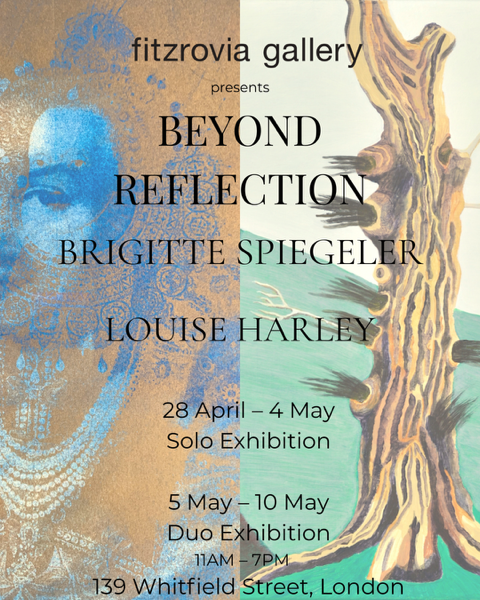
At a moment when reflection is increasingly mediated by screens, Beyond Reflection repositions it as a spatial, material, and temporal act—one that unfolds through light, movement, and the presence of place.
Fitzrovia Gallery presents Beyond Reflection, a two-part exhibition by Brigitte Spiegeler and Louise Harley that examines the conditions of seeing, locating, and reflecting in relation to place.
Spiegeler’s practice engages with the layered meanings embedded in historical, legal, and geographical contexts. Her works approach sites not as fixed locations, but as accumulations of time and resonance. For Beyond Reflection, she presents a new series of analogue camera obscura photographs made in London’s Inns of Court. These images register duration rather than document architecture: forms appear softened, suspended, and on the verge of dissolution.
In several works, gold leaf is introduced as a material intervention, producing a restrained luminosity that points towards what persists beyond the visible. This aligns with Spiegeler’s notion of The Other Realm—an intangible yet perceptible dimension in which memory and energy continue to operate. Within this framework, the image functions less as representation than as threshold.
The presentation also includes new works from Spiegeler’s ongoing Icon series, notably a risographic interpretation of Elizabeth I. Through layered colour and subtle misalignment, the figure is rendered unstable—circulating between historical image and contemporary construction.
The exhibition unfolds in two phases. In its initial configuration, Spiegeler’s works establish a spatial and conceptual structure centred on reflection and the positioning of place within London’s cultural and legal topography. This configuration is subsequently altered, making way for the introduction of Louise Harley.
Harley’s practice focuses on acts of attention and orientation. Her drawings, in Japanese ground ink and German pigment ink on Zanders Parole paper, depict found objects encountered in situ—elements that operate simultaneously as part of the landscape and as points of mental focus. Her paintings extend this inquiry, presenting natural forms and living beings as markers within space: fixed points through which navigation and meaning are constructed.
If Spiegeler’s work attends to the temporal density of place, Harley’s concerns lie with the present tense of locating oneself within it. Together, their practices propose reflection not as a passive condition, but as an active process—one that unfolds through movement, repositioning, and encounter.
In a moment increasingly shaped by digital self-imaging, Beyond Reflection offers a slower, materially grounded proposition: reflection as something contingent, spatial, and shared.